
Mortgage Length by Country: US vs UK vs Canada vs Australia (Big Differences Revealed)
The average mortgage length differs by country. The US typically uses 30-year loans, while the UK averages around 25 years, and Canada and Australia use shorter fixed-term structures with renewals.
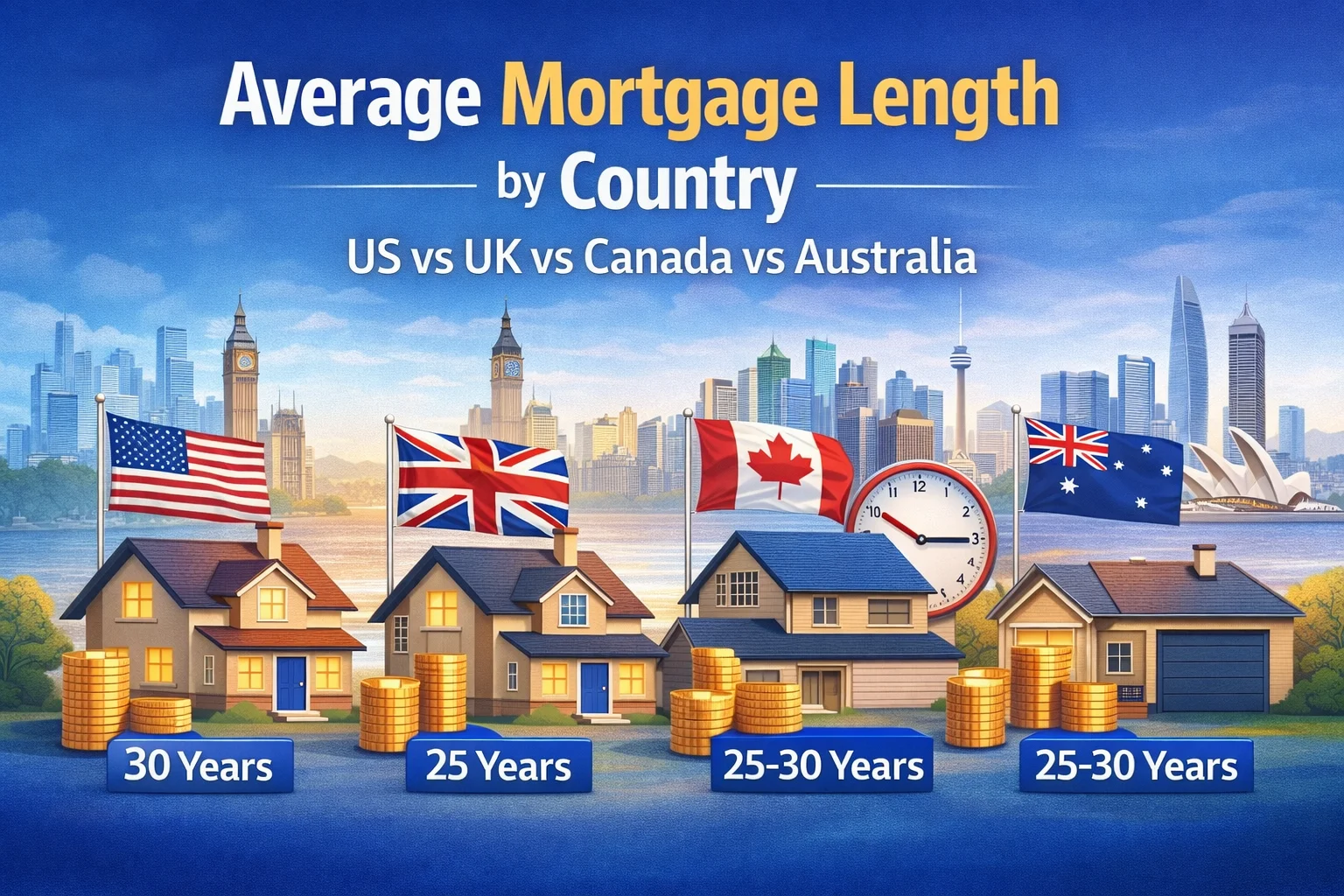
Mortgage terms are not the same around the world, and understanding these differences can give you a major advantage when comparing home loans.
While the United States is known for its 30-year mortgage structure, countries like the UK, Canada, and Australia follow different systems that affect payments, refinancing, and long-term costs.
In this guide, we’ll break down how mortgage lengths vary globally and what that means for borrowers.
While systems differ globally, the average mortgage length still depends heavily on borrower behavior and refinancing trends.
Mortgage Calculator
Results
Extra Payment Impact
WHAT DOES “MORTGAGE LENGTH” MEAN GLOBALLY
Mortgage length generally refers to how long you have to repay your home loan, but globally, it’s not always that simple.
In some countries, the loan term and interest rate period are separate concepts. For example, you may have a 25-year repayment period but only a 5-year fixed interest rate.
Understanding this difference is critical when comparing international systems.
If you’re new to mortgages, learning from mortgage basics explained simply can help you clearly understand how loan terms actually work across different countries.
AVERAGE MORTGAGE LENGTH IN THE US
In the United States, the standard mortgage length is 30 years, making it one of the longest-term systems globally.
This structure allows borrowers to keep monthly payments relatively low, which improves affordability.
However, most homeowners don’t keep their mortgage for the full term and instead refinance or move within 10 to 12 years.
Many borrowers monitor current 30 year rates and compare them with 15 year mortgage rates to decide whether switching terms could save money or reduce long-term interest costs.
AVERAGE MORTGAGE LENGTH IN THE UK
In the UK, the typical mortgage length is around 25 years, but the structure is quite different from the US. Borrowers usually lock in a fixed interest rate for only 2 to 5 years before switching to a new deal.
This means refinancing is much more frequent compared to the US system. As a result, borrowers need to stay updated with rate changes and market trends.
The UK model offers flexibility but also exposes borrowers to more interest rate fluctuations over time.
AVERAGE MORTGAGE LENGTH IN CANADA
Canada uses a unique system that many borrowers misunderstand. While the total amortization period is usually 25 to 30 years, the mortgage term itself is often just 5 years.
After this period, borrowers must renew their loan at current interest rates.
This creates a cycle of regular refinancing, even if the homeowner stays in the same property long-term.
Because of this structure, Canadian borrowers are highly sensitive to rate changes and often plan their finances around renewal periods.
AVERAGE MORTGAGE LENGTH IN AUSTRALIA
In Australia, mortgage lengths typically range from 25 to 30 years, similar to the US. However, most loans are variable-rate rather than fixed.
This means borrowers experience frequent changes in monthly payments based on interest rate movements.
Australian mortgages also allow flexible repayment options, including extra payments and redraw facilities.
This flexibility can help borrowers reduce loan duration faster, but it also requires careful financial planning to manage changing interest rates effectively.
KEY DIFFERENCES BETWEEN COUNTRIES
| Country | Typical Length | Fixed Period | System |
|---|---|---|---|
| US | 30 years | Long-term | Fixed dominant |
| UK | 25 years | 2–5 years | Mixed |
| Canada | 25–30 years | 5 years | Renewal system |
| Australia | 25–30 years | Variable | Flexible |
Mortgage systems differ significantly across countries due to how interest rates and lending structures are designed.
The US offers long-term fixed stability, while the UK uses short-term fixed deals. Canada focuses on renewal cycles, and Australia emphasizes flexibility through variable rates.
These differences affect how often borrowers refinance, how predictable payments are, and how much interest is paid over time.
Understanding these variations can help you better compare loan options and avoid costly assumptions when evaluating mortgage terms globally.
WHY MORTGAGE LENGTH VARIES BY COUNTRY
Mortgage length varies because of economic policies, banking regulations, and housing market conditions.
In the US, government-backed loans support long-term fixed mortgages, while other countries rely more on market-driven systems.
Interest rate environments also play a role, influencing whether lenders offer long or short fixed terms.
Additionally, affordability challenges push countries to adopt structures that balance risk for both lenders and borrowers. These factors combine to create very different mortgage experiences worldwide.
WHICH COUNTRY HAS THE BEST MORTGAGE SYSTEM
There is no single “best” mortgage system, as each country offers different advantages. The US provides stability with fixed long-term rates, while Canada offers flexibility through renewals.
The UK’s system allows borrowers to adapt frequently, and Australia provides repayment flexibility with variable loans. The best option depends on your financial goals, risk tolerance, and market conditions.
Understanding these systems helps you choose what works best for your situation rather than assuming one model is superior.
HOW THIS AFFECTS YOU AS A BORROWER
Mortgage length directly impacts your monthly payments, refinancing frequency, and total interest paid.
A longer loan reduces monthly costs but increases overall interest, while shorter terms do the opposite.
If you’re planning to compare options, using a mortgage calculator can help you estimate payments across different loan lengths.
This allows you to make informed decisions based on your income, financial goals, and how long you plan to stay in your home.
🔄 See How Refinancing Changes Your Loan
Estimate how refinancing can reduce your interest, monthly payment, or even shorten your mortgage length.
Try Refinance Calculator →SHOULD YOU CHOOSE A SHORT OR LONG MORTGAGE
Choosing between a short or long mortgage depends on your priorities. A long-term loan like 30 years offers lower monthly payments and flexibility, while a shorter loan reduces interest and builds equity faster.
If you’re unsure, using a mortgage term calculator can help you compare scenarios and see how different terms affect your finances.
The right choice is not universal—it depends on your budget, long-term plans, and tolerance for higher monthly payments.
🏡 Find the Right Mortgage Length for You
Check what mortgage length fits your budget based on your income and monthly affordability.
Try Affordability Calculator →Frequently Asked Questions
Conclusion
Mortgage length varies significantly across countries, and these differences can impact everything from your monthly payment to your long-term financial strategy.
While the US offers long-term stability, countries like Canada, the UK, and Australia provide more flexible but dynamic systems.
Understanding these structures helps you make smarter decisions, especially if you’re comparing global markets or planning your next home purchase.
The key is choosing a mortgage that aligns with your financial goals and future plans.
Mortgage Calculator
Recommended Mortgage Tools
Refinance Break-Even Calculator
See how long it takes to recover refinance costs.
Debt-to-Income Ratio Calculator
Check if your income supports mortgage approval.
Refinance Readiness Checker
Find out if now is the right time to refinance.
Mortgage Eligibility Checker
Quickly see if you qualify for a home loan.
First-Time Buyer Readiness
Know if you're ready to buy your first home.
Mortgage Pre-Approval Calculator
Estimate how much you can borrow instantly.
Next Read
Featured Mortgage Insights
Mortgage payments often feel like they should stay the same forever, especially if you have a fixed-rate loan. But..

Featured Mortgage Insights
A monthly mortgage payment is more than just paying back the loan. Many first-time buyers focus only on the..
Featured Mortgage Insights
Homebuyers are starting their mortgage research much earlier than in previous years, often exploring loan options and rate trends months before house hunting. Early planning helps buyers understand affordability, prepare finances, and avoid surprises during mortgage approval and closing stages.




About the Author: Ratiranjan Singha

Don’t Miss These