Check today’s FHA streamline refinance rates (April 2026)
As of April 2026, FHA streamline refinance rates are about 6.33% for 30-year terms and 5.75% for 15-year loans. Available to current FHA borrowers, this program offers simplified refinancing with minimal documentation and requires a clear financial benefit.
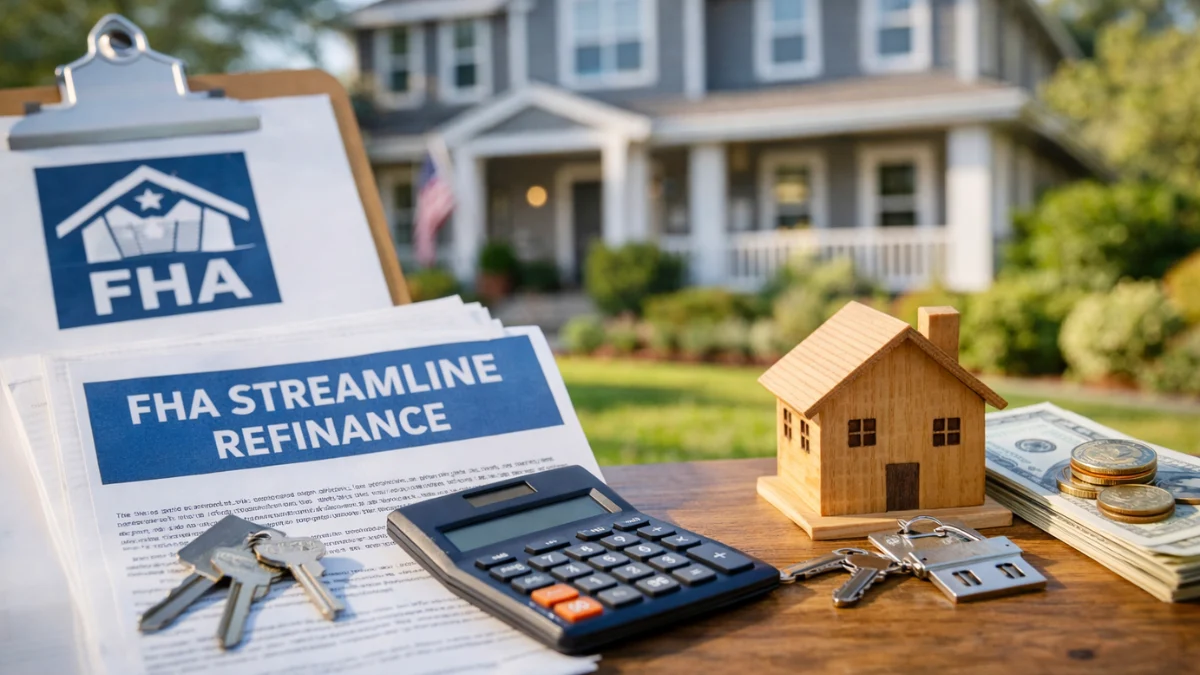
Understanding FHA refinance rates today is essential for homeowners thinking about lowering their mortgage interest rate, reducing monthly payments, or changing loan terms.
FHA refinance loans are insured by the Federal Housing Administration, typically offering more flexible qualification standards and competitive pricing especially for borrowers who might not qualify for conventional refinancing.
FHA streamline refinance rates today offer homeowners an easy way to reduce monthly mortgage payments with minimal paperwork.
As of early April 2026, 30-year FHA streamline rates are around 6.33%, while 15-year terms are lower near 5.75%.
This program is designed for existing FHA borrowers, requiring no appraisal and limited documentation.
To qualify, homeowners must demonstrate a net tangible benefit, such as a lower interest rate or reduced monthly cost, making it a popular low-hassle refinancing option.
What “FHA Refinance Rates Today” Mean
When people talk about FHA refinance rates today, they’re usually referring to average interest rates lenders are offering on new FHA refinance loans including both FHA simple or rate-and-term refinances and FHA cash-out refinances.
These rates reflect nationwide trends and help you compare against your current mortgage or other loan options.
Typical FHA Refinance Rate Benchmarks
Recent national rate surveys show:
- 30-year FHA refinance average rate around 6.62% interest, though actual pricing varies by lender and profile.
- FHA refinance benchmarks may appear a bit higher than current purchase FHA rates because refinance pricing reflects loan purpose and market movement.
These figures change as broader mortgage rates shift, but they give you a rough sense of where FHA refinance pricing lies in the current market.
How FHA Refinance Rates Compare to Other Loan Types
FHA loans are government-insured, so lenders often offer competitive pricing relative to conventional refinance rates especially for borrowers with moderate credit scores.
However, FHA refinance rates may still be slightly above the absolute lowest conventional rates depending on market conditions and individual risk profiles.
Major Factors That Influence FHA Refinance Rates
Your actual FHA refinance rate can vary due to several key factors:
- Credit Score and Financial Profile: Higher scores typically result in better refinance rates.
- Loan-to-Value (Equity): More home equity can help with pricing though FHA programs are more flexible than many conventional options.
- Market Conditions: Broader mortgage rate trends, such as long-term Treasury yields or inflation expectations, influence FHA refinance rates.
These variables explain why two borrowers applying for the same FHA refinance can receive different rate offers even on the same day.
FHA Streamline Refinance Rates
For homeowners who already have an FHA loan, an FHA Streamline Refinance is a common way to secure a lower rate with minimal paperwork and underwriting.
This option often allows you to refinance into today’s lower FHA rate potentially without a home appraisal or income verification as long as the refinance delivers a net benefit (like a lower monthly payment).
FHA Cash-Out Refinance Rates
If your goal is to access home equity, an FHA cash-out refinance may come with slightly different rate expectations.
Because the loan balance increases when you take cash out, lenders may price these loans a bit differently than simple or streamline refinances but FHA’s government insurance still allows competitive terms relative to many conventional cash-out options.
How Today’s Mortgage Market Affects FHA Refinance Rates
Overall mortgage rates have recently fallen to multi-year lows, with average 30-year fixed mortgage rates dipping near 6.06%, which improves the context for FHA refinance pricing too.
Lower long-term rates often translate into better FHA refinance options, especially for borrowers with solid credit and sufficient equity.
When Current FHA Refinance Rates Make Sense
Today’s FHA refinance rates are generally attractive if:
- They’re meaningfully lower than your current mortgage rate
- You plan to stay in your home long enough to recover closing costs
- Your financial profile lines up with lender expectations
If a refinance can reduce your total interest cost or monthly payment, then today’s FHA refinance environment may be favorable.
Comparing Rate vs. Total Loan Cost
Interest rate alone doesn’t tell the whole story. FHA refinance loans require mortgage insurance premiums (MIP), which add to total cost.
When comparing refinance options, it’s important to look at APR (which includes costs) rather than just the quoted interest rate.
This ensures you understand the true cost of your refinance.
Conclusion
FHA refinance rates today serve as a benchmark, but the best way to determine your rate is by comparing personalized offers based on your credit score, equity, loan term, and refinance goals such as a FHA Streamline Refinance to lower payments or an FHA cash-out refinance to access equity.
When current refinance rates meaningfully improve your financial picture, refinancing with FHA can be a valuable tool for long-term savings and stability.
Mortgage Calculator
Recommended Mortgage Tools
Refinance Break-Even Calculator
See how long it takes to recover refinance costs.
Debt-to-Income Ratio Calculator
Check if your income supports mortgage approval.
Refinance Readiness Checker
Find out if now is the right time to refinance.
Mortgage Eligibility Checker
Quickly see if you qualify for a home loan.
First-Time Buyer Readiness
Know if you're ready to buy your first home.
Mortgage Pre-Approval Calculator
Estimate how much you can borrow instantly.
Next Read
Featured Mortgage Insights
Home loans are significantly influencing confidence levels among first-time buyers as affordability challenges and mortgage rate uncertainty reshape purchasing decisions. Many new buyers are carefully evaluating financial readiness before committing, balancing homeownership goals with long-term payment stability.

Featured Mortgage Insights
For many buyers, mortgage security now matters more than simply getting the lowest possible rate. Stability, predictable payments, and long-term financial safety are becoming bigger priorities than short-term interest savings in today’s housing market.
Featured Mortgage Insights
Home loans are increasingly influencing long-term budgeting decisions as buyers evaluate how mortgage commitments affect savings, lifestyle spending, and financial security. Borrowers are planning housing costs more carefully to maintain stability throughout years of repayment.



About the Author: Ratiranjan Singha

Don’t Miss These