Mortgage Term vs Loan Tenure: The Hidden Difference Most Buyers Miss
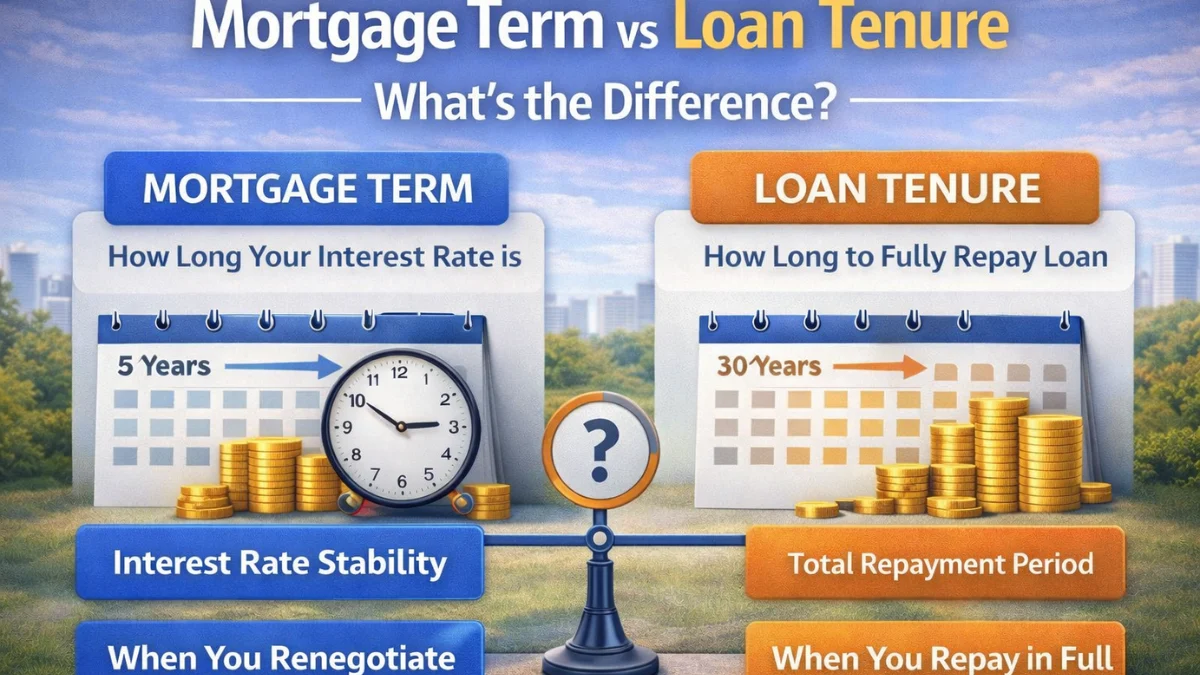
Mortgage term is the period your interest rate is fixed, while loan tenure is the total time to repay the loan. Both impact payments, refinancing, and total interest.
Mortgage term and loan tenure are often confused, especially by first-time buyers. While they may sound similar, they refer to different aspects of a home loan.
Understanding the difference is crucial because it affects your interest rate, monthly payments, and refinancing decisions.
In this guide, you’ll learn what mortgage term and loan tenure mean, how they work together, and how to choose the right combination for your financial situation.
Understanding these concepts helps explain the average mortgage length and why it varies between borrowers.
WHAT IS A MORTGAGE TERM?
A mortgage term is the length of time your loan conditions, especially the interest rate, remain fixed or unchanged.
This period can range from a few years to the full duration of the loan, depending on the country and loan type.
For example, in some countries, mortgage terms are only 2 to 5 years, after which borrowers must renew or refinance.
Understanding this concept is easier when you explore mortgage basics explained before selecting your loan.
WHAT IS LOAN TENURE?
Loan tenure refers to the total length of time you have to repay your mortgage in full. This is typically 15, 20, or 30 years.
It determines your monthly payment amount and the total interest you will pay over the life of the loan.
A longer tenure reduces monthly payments but increases total interest, while a shorter tenure does the opposite.
Loan tenure is the full timeline of your mortgage, regardless of how many times you refinance or change terms.
KEY DIFFERENCE BETWEEN MORTGAGE TERM AND LOAN TENURE
The key difference is that mortgage term focuses on how long your current interest rate and conditions last, while loan tenure refers to the full repayment period of your loan.
For example, you might have a 30-year loan tenure but only a 5-year mortgage term.
After the term ends, you may need to renew or refinance your loan. This distinction is crucial for understanding how mortgages work in different countries.
HOW THESE AFFECT YOUR MONTHLY PAYMENTS
Both mortgage term and loan tenure influence your monthly payments, but in different ways.
Loan tenure directly affects how much you pay each month, while mortgage term affects your interest rate stability.
A shorter tenure increases monthly payments but reduces interest, while a shorter term may expose you to changing rates sooner.
Using a mortgage calculator can help you understand how these factors combine to impact your monthly budget.
HOW THEY IMPACT INTEREST AND TOTAL COST
Loan tenure has a direct impact on total interest costs. A longer tenure means you pay more interest over time.
Mortgage term, on the other hand, determines how often your interest rate may change. Shorter terms may lead to refinancing at different rates, which can increase or decrease your total cost.
Understanding both helps you plan your mortgage more effectively and avoid unexpected financial surprises.
WHICH IS MORE IMPORTANT FOR BORROWERS
Both mortgage term and loan tenure are important, but their importance depends on your financial goals.
If you want stability, the mortgage term is crucial because it determines how long your rate stays fixed. If you want to minimize costs, loan tenure becomes more important.
Most borrowers need to balance both factors to create a mortgage strategy that fits their needs.
HOW THIS DIFFERS BY COUNTRY
Mortgage systems vary globally. In the US, mortgage terms often match the loan tenure, meaning you can have a fixed rate for 30 years.
In countries like Canada and the UK, mortgage terms are shorter, requiring frequent renewals.
This makes understanding the difference even more important when comparing international mortgage systems or planning to buy property abroad.
COMMON MISTAKES BORROWERS MAKE
Many borrowers assume mortgage term and loan tenure mean the same thing, which can lead to poor decisions.
Some focus only on monthly payments without considering interest rate changes, while others ignore refinancing risks.
Understanding both concepts helps you avoid these mistakes and choose a loan structure that aligns with your financial goals and risk tolerance.
WHICH SHOULD YOU FOCUS ON
You should focus on both mortgage term and loan tenure when choosing a loan. Consider how long you plan to stay in your home and whether you prefer stability or flexibility.
Using a mortgage affordability calculator can help you evaluate how different combinations affect your finances and guide you toward the best option.
Frequently Asked Questions
Conclusion
Understanding the difference between mortgage term and loan tenure is essential for making informed financial decisions.
While loan tenure determines how long you repay your loan, mortgage term affects how often your interest rate can change.
By balancing both factors, you can choose a mortgage that fits your financial goals, provides stability, and minimizes long-term costs.
Mortgage Calculator
Recommended Mortgage Tools
Refinance Break-Even Calculator
See how long it takes to recover refinance costs.
Debt-to-Income Ratio Calculator
Check if your income supports mortgage approval.
Refinance Readiness Checker
Find out if now is the right time to refinance.
Mortgage Eligibility Checker
Quickly see if you qualify for a home loan.
First-Time Buyer Readiness
Know if you're ready to buy your first home.
Mortgage Pre-Approval Calculator
Estimate how much you can borrow instantly.
Next Read
Featured Mortgage Insights
The average mortgage length for first-time buyers is usually 30 years, but most don’t keep the loan that long. Many refinance or move within 10 to 12 years.

Featured Mortgage Insights
Most people don’t keep their 30-year mortgage. On average, homeowners stay in a loan for about 10 to 12 years due to refinancing, moving, or upgrading homes.
Featured Mortgage Insights
Short mortgages save interest and build equity faster, while long mortgages offer lower monthly payments and flexibility. The best option depends on your budget, goals, and financial stability.



About the Author: Ratiranjan Singha

Don’t Miss These

Home Loans Explained: Types, Rates & How They Work

Refinancing Your Mortgage: Rates, Costs & Smart Tips