Explore Options to Help Pay for College
College expenses can add up beyond tuition, including books, housing, and other education costs. Explore student loan options and compare interest rates, fees, eligibility, and repayment terms. If you’re in the US, review federal student aid before considering private student loans.
To keep this site free, We may earn compensation from partners at no cost to you. We are not a lender, and all loan decisions are made by third parties. Learn more in our Affiliate Disclosure, Advertiser Disclosure, and Disclaimer.

Paying for college can feel overwhelming when tuition, housing, books, transportation, and everyday expenses add up. A student loan can help cover education costs, but the amount you borrow and the terms you accept can affect your finances long after graduation.
The best approach is to explore grants and scholarships first, understand your federal student loan options, and compare private lenders only when additional funding is necessary.
Approval is important, but so is choosing a loan you can realistically repay. Here’s how to navigate the process and keep borrowing costs under control.
What Is a Student Loan and How Does It Work?
A student loan is money borrowed to pay eligible education expenses, generally repaid over time with interest. Depending on the loan, repayment may begin while you are studying or after you leave school, graduate, or drop below the required enrollment level.
In the United States, student loans generally fall into two categories:
- Federal student loans: Offered through the federal student aid system, with eligibility rules and repayment benefits established by law.
- Private student loans: Offered by banks, credit unions, and other private lenders. Approval, interest rates, repayment terms, and borrower protections depend on the lender and loan agreement.
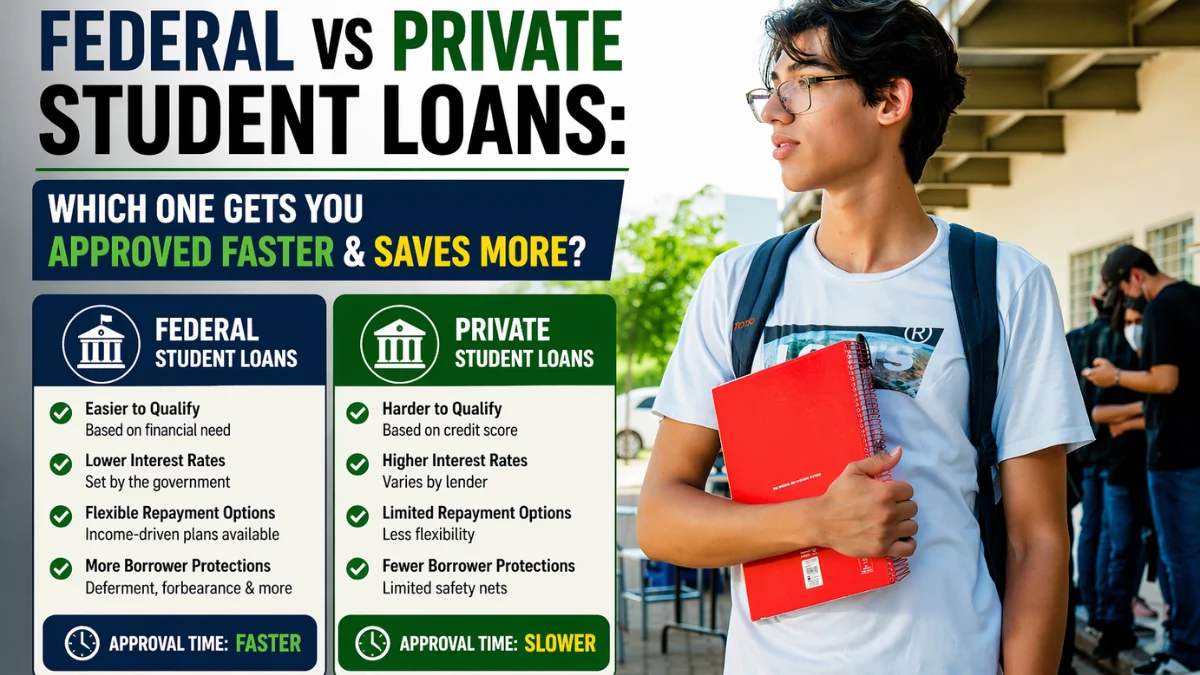
Federal and private loans are not interchangeable. Federal loans generally offer standardized borrower protections and access to eligible federal repayment programs. Private loans may help cover a funding gap, but they typically do not provide the same federal benefits.
Before applying, learn what a student loan is and how the two main loan types differ.
How to Apply for a Student Loan
The application process depends on whether you need federal or private financing. Following the right order can help you avoid unnecessary borrowing and applications.
Calculate how much you actually need
Start with your school’s estimated cost of attendance. Include tuition, fees, housing, food, books, transportation, and other eligible education expenses. Then subtract grants, scholarships, savings, family contributions, and other funding you do not need to repay.
For example, if your estimated education costs are $24,000 and grants, scholarships, and available funds cover $15,000, your remaining funding gap is $9,000. That does not automatically mean you should borrow the entire amount; first check whether your expenses can be reduced or covered through other aid.
Complete the FAFSA
For federal student aid in the United States, complete the Free Application for Federal Student Aid (FAFSA) at the official Federal Student Aid website.
The form helps determine eligibility for federal grants, work-study, and federal student loans. States and colleges may also use FAFSA information when awarding their own aid. The 2026–27 FAFSA is available, but state and school deadlines can differ.
Use the official website rather than a third-party site that charges you to submit the FAFSA. Provide accurate information and complete any requested follow-up steps.
Review your financial aid offer
Once your school processes your information, review the aid offer carefully. Check the type and amount of each award, the estimated remaining cost, and any conditions you must meet.
Grants and scholarships generally do not need to be repaid when you follow their conditions. Loans do. Do not accept a loan simply because it appears in your offer; decide how much you need after reviewing the full cost of attendance and your other resources.
Complete the federal loan requirements
If you accept a federal student loan, follow the instructions from your school and the federal student aid system.
Depending on your circumstances, you may need to sign a promissory note and complete entrance counseling. Check the loan type, amount, interest terms, and disbursement details before proceeding.
For a more detailed walkthrough, see how to apply for a student loan.
Compare private student loans if you still have a funding gap
If federal aid and other resources do not cover your remaining eligible expenses, compare private student loan offers. Check the annual percentage rate (APR), fixed or variable rate, fees, repayment options, cosigner requirements, and hardship policies.
Submit applications only after reviewing each lender’s eligibility requirements. Multiple applications may lead to credit inquiries, depending on the lender and application process.
What to Read Next?
How to Get Approved for a Student Loan
Approval depends on the loan type. Federal student aid eligibility is determined under federal rules and is not generally based on the same credit approval process used by private lenders. Private lenders typically assess credit history, income or ability to repay, and other risk factors.

Understand the eligibility requirements
For federal aid, eligibility can depend on factors such as citizenship or eligible noncitizen status, enrollment in an eligible program, satisfactory academic progress, and completion of required application steps. Specific requirements vary by aid type.
Private lenders may consider:
- Credit history: A stronger credit profile may help you qualify for better terms.
- Income and repayment ability: Some lenders require evidence that you or a cosigner can afford repayment.
- Cosigner eligibility: Students with limited credit history may need a creditworthy cosigner.
- School and program eligibility: The lender may restrict which institutions or programs qualify.
- Loan amount: The amount requested must fit within the lender’s rules and applicable borrowing limits.
A cosigner may improve your chances of qualifying for a private loan, but they also become legally responsible for the debt under the agreement. Make sure both parties understand that obligation before signing.

Prepare the documents you may need
Requirements vary, but private lenders may request identification, contact details, school and enrollment information, estimated education costs, income information, and details about existing financial obligations. A cosigner may need to provide similar information.
For federal aid, gather the information required for the FAFSA and respond to any verification requests from your school. Use accurate details throughout the process; incorrect or inconsistent information can delay your application.

What if your application is denied?
Ask the lender for the reasons and review whether you can address them. You might need a cosigner, a smaller loan, corrected credit-report information, or another funding source. If federal aid is involved, contact your school’s financial aid office to ask about your options.
Avoid lenders promising guaranteed approval in exchange for upfront fees. No legitimate lender can guarantee that every applicant will qualify.
Federal vs. Private Student Loans: Which Should You Choose?
The right option depends on your eligibility, remaining education costs, and the terms available to you.
| Feature | Federal student loans | Private student loans |
|---|---|---|
| Application | Generally starts with FAFSA | Apply directly through a lender |
| Approval | Federal eligibility requirements | Lender-specific underwriting |
| Interest rate | Set under federal rules for applicable loan types and disbursement periods | May be fixed or variable |
| Repayment options | Federal repayment programs, subject to eligibility and current rules | Options vary by lender and contract |
| Credit or cosigner | Generally not the same credit-based approval process as private loans for most student Direct Loans | Credit review and a cosigner may be required |
| Borrower protections | Federal protections and benefits may apply | Contract-specific protections; federal benefits do not automatically apply |
Before accepting either type, review the loan’s total cost and repayment obligations. A lower initial payment does not necessarily mean a cheaper loan over its full term.
Read federal vs. private student loans to understand the trade-offs before choosing.
How Student Loan Interest Works
Student loan interest is the cost of borrowing. The amount you pay depends on your outstanding balance, interest rate, repayment period, and how interest is handled during school and repayment.
For federal loans, interest rates depend on the loan type and the applicable disbursement period. Rates for new federal loans can change from one academic year to another, while the rate on a particular fixed-rate loan generally remains the same for its term. Private lenders may offer fixed or variable rates, so compare the contract carefully.
Interest can also accumulate differently depending on your loan terms. For example, if interest accrues while you are studying and remains unpaid, certain events may cause it to be added to the principal balance. That process is called capitalization, and it can increase the amount on which future interest is calculated.
To understand the costs that may affect your balance, review student loan interest.
7 Ways to Pay Less Interest on a Student Loan

Borrow only what you need
The most direct way to reduce borrowing costs is to keep the original balance as low as reasonably possible. Review your financial aid offer, search for scholarships, and consider whether lower-cost housing, used textbooks, or other realistic budget changes can reduce the amount you need to borrow.
Do not borrow the maximum simply because it is available. Every additional dollar may increase the interest you pay.

Compare the total cost, not just the monthly payment
A longer repayment term can reduce the required monthly payment, but it may increase the total interest paid. Compare APR, fees, monthly payments, repayment length, and total repayment amount before accepting a private loan.
If two loans have similar terms, the lower-cost offer may save money. But make sure you compare equivalent loan amounts and repayment periods.

Look for scholarships and grants before borrowing more
Scholarships and grants can reduce your need for loans. Check your school’s financial aid office, local organizations, professional associations, and legitimate scholarship databases. Review award conditions and deadlines carefully.
Even a relatively small grant can reduce the amount you need to finance and the interest that may accumulate over time.

Choose a repayment term you can afford
A shorter repayment term generally means less time for interest to accumulate, but it also means higher required payments. Choose a term that fits your realistic budget rather than one that could leave you short on rent, food, transportation, or emergency savings.
If a longer term is necessary to make payments manageable, consider whether you can make additional payments later without a prepayment penalty, subject to your loan agreement.

Make extra payments when practical
If your budget allows, paying more than the required amount may reduce your principal balance sooner and lower future interest. Confirm how your servicer applies extra payments and whether any special instructions are needed.
Do not use money needed for essential expenses or emergency savings simply to make extra loan payments. Consistency matters more than an aggressive payment that becomes unsustainable.

Check whether automatic payments can reduce your rate
Some student loan servicers offer an interest-rate reduction for eligible borrowers who enroll in automatic payments. The amount, eligibility requirements, and duration depend on the loan and applicable program rules.
Confirm the current benefit with your servicer before relying on it. Keep enough money in your account to cover scheduled withdrawals and avoid overdraft fees.

Review repayment options before refinancing
Federal borrowers may qualify for repayment options tied to income or fixed payment schedules, depending on their loan types and when the loans were disbursed. Private lenders have their own repayment terms.
Refinancing through a private lender may reduce your rate if you qualify, but refinancing federal loans into a private loan generally means giving up federal benefits and protections attached to those loans. Compare the full consequences, not only the advertised rate before making a decision.
For practical repayment strategies, read how to pay off student loans faster.
Which Student Loan Repayment Plan Should You Choose?
Your best repayment plan depends on your balance, income, loan type, financial goals, and eligibility. A fixed-payment plan can provide predictability, while an eligible income-driven plan may help align payments with your income. Lower required payments can make monthly budgeting easier, but they do not always produce the lowest total cost.
Important for U.S. borrowers: Federal repayment rules changed in 2026. The Tiered Standard plan and Repayment Assistance Plan (RAP) became available starting July 1, 2026. Eligibility for these and other plans depends on factors including loan type and disbursement date.
Some plans available to earlier borrowers may not be available to borrowers with new loans disbursed on or after that date. Check the official Federal Student Aid repayment-plan guidance before selecting a plan.
Compare the monthly payment, repayment duration, interest treatment, and any forgiveness conditions that may apply. Do not assume that a plan with the lowest payment will necessarily cost the least over time.
Use the student loan repayment calculator to estimate how different balances, rates, and repayment periods may affect your budget. Treat the result as an estimate and verify actual terms with your lender or servicer.
Student Loan Mistakes to Avoid
A few common mistakes can make education borrowing more expensive than necessary:
- Accepting more than you need: Extra borrowing can increase your future payment burden.
- Ignoring the interest rate: A small difference in rates can matter over a long repayment period.
- Choosing a loan based only on the monthly payment: Check the full repayment cost and length.
- Missing deadlines: FAFSA, school aid, and scholarship deadlines may differ.
- Overlooking cosigner responsibilities: A cosigner may be legally responsible if you do not repay.
- Refinancing without checking lost benefits: Moving federal debt to a private loan can eliminate federal protections.
- Ignoring repayment notices: Keep your contact details current and review messages from your school, lender, or loan servicer.
If you already have several loans, compare their balances, rates, and repayment terms before deciding whether consolidation or another strategy could help. Consolidation is not automatically a way to reduce interest.
See student loan mistakes to avoid for more guidance.
Conclusion
Getting a student loan is not just about securing enough money for college. It is about funding your education while keeping future repayments manageable. Start by completing the FAFSA, reviewing your financial aid offer, and using grants or scholarships to reduce the amount you need to borrow.
If you need a private loan, compare rates, fees, repayment terms, and cosigner requirements carefully.
Once you borrow, keep track of your balance and interest, review repayment options when your circumstances change, and make extra payments when your budget allows. A little planning before signing can help you avoid unnecessary debt and make repayment more manageable after graduation.

About Us
We’re MortgageRatesChecker, a financial education and tools platform helping consumers make smarter decisions about borrowing, budgeting, saving, and everyday spending. We provide practical guides, calculators, and resources covering mortgages, loans, home buying, refinancing, personal finance, money management, and budget-conscious travel. Explore our guides, calculators, and resources to make more informed financial decisions.
Disclaimer
MortgageRatesChecker provides educational mortgage calculators, loan tools, and financial guides designed to help you better understand home financing. Our content is researched, fact-checked, and regularly updated in accordance with our Editorial Policy, using trusted information from our Data Sources and transparent methodologies explained in How We Calculate. Learn more about our commitment to accuracy on Why Trust Us. This content is provided for informational purposes only and should not be considered financial, legal, tax, investment, or mortgage advice. Mortgage rates, lending requirements, loan programs, and regulations may change without notice. Before making any borrowing, refinancing, or home-buying decision, consult your Bank or Mortgage Lender, licensed financial advisor, tax professional, or attorney based on your individual circumstances. MortgageRatesChecker is an independent educational resource and is not a lender, mortgage broker, financial advisor, or government agency. Please review our Affiliate Disclosure, Advertiser Disclosure, Disclaimer, and Terms & Conditions for additional information.