
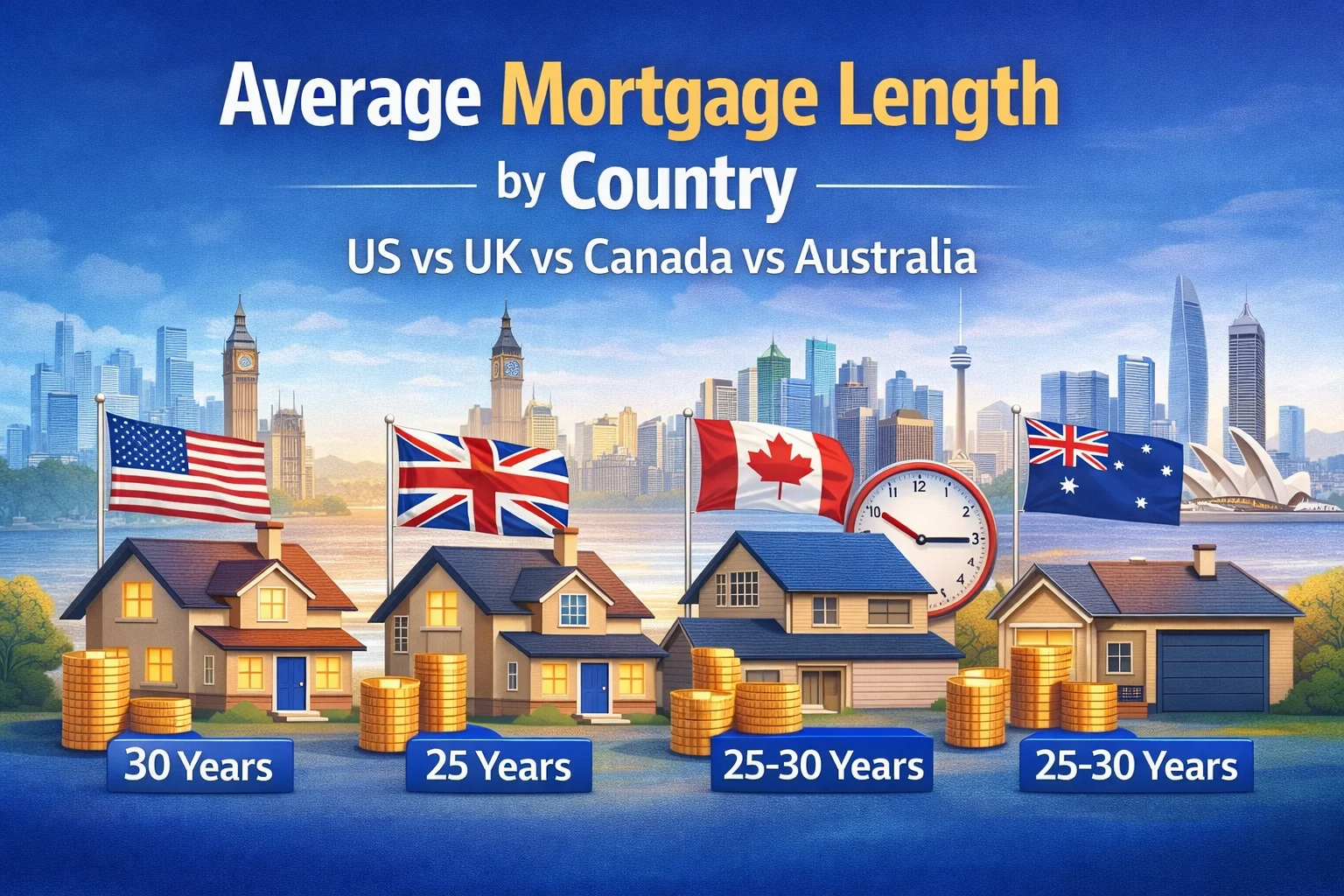
Mortgage terms are not the same around the world, and understanding these differences can give you a major advantage when comparing home loans.
While the United States is known for its 30-year mortgage structure, countries like the UK, Canada, and Australia follow different systems that affect payments, refinancing, and long-term costs.
In this guide, we’ll break down how mortgage lengths vary globally and what that means for borrowers.
While systems differ globally, the average mortgage length still depends heavily on borrower behavior and refinancing trends.
Mortgage Calculator
Results
Extra Payment Impact
WHAT DOES “MORTGAGE LENGTH” MEAN GLOBALLY
Mortgage length generally refers to how long you have to repay your home loan, but globally, it’s not always that simple.
In some countries, the loan term and interest rate period are separate concepts. For example, you may have a 25-year repayment period but only a 5-year fixed interest rate.
Understanding this difference is critical when comparing international systems.
If you’re new to mortgages, learning from mortgage basics explained simply can help you clearly understand how loan terms actually work across different countries.
AVERAGE MORTGAGE LENGTH IN THE US
In the United States, the standard mortgage length is 30 years, making it one of the longest-term systems globally.
This structure allows borrowers to keep monthly payments relatively low, which improves affordability.
However, most homeowners don’t keep their mortgage for the full term and instead refinance or move within 10 to 12 years.
Many borrowers monitor current 30 year rates and compare them with 15 year mortgage rates to decide whether switching terms could save money or reduce long-term interest costs.
AVERAGE MORTGAGE LENGTH IN THE UK
In the UK, the typical mortgage length is around 25 years, but the structure is quite different from the US. Borrowers usually lock in a fixed interest rate for only 2 to 5 years before switching to a new deal.
This means refinancing is much more frequent compared to the US system. As a result, borrowers need to stay updated with rate changes and market trends.
The UK model offers flexibility but also exposes borrowers to more interest rate fluctuations over time.
AVERAGE MORTGAGE LENGTH IN CANADA
Canada uses a unique system that many borrowers misunderstand. While the total amortization period is usually 25 to 30 years, the mortgage term itself is often just 5 years.
After this period, borrowers must renew their loan at current interest rates.
This creates a cycle of regular refinancing, even if the homeowner stays in the same property long-term.
Because of this structure, Canadian borrowers are highly sensitive to rate changes and often plan their finances around renewal periods.
AVERAGE MORTGAGE LENGTH IN AUSTRALIA
In Australia, mortgage lengths typically range from 25 to 30 years, similar to the US. However, most loans are variable-rate rather than fixed.
This means borrowers experience frequent changes in monthly payments based on interest rate movements.
Australian mortgages also allow flexible repayment options, including extra payments and redraw facilities.
This flexibility can help borrowers reduce loan duration faster, but it also requires careful financial planning to manage changing interest rates effectively.
KEY DIFFERENCES BETWEEN COUNTRIES
| Country | Typical Length | Fixed Period | System |
|---|---|---|---|
| US | 30 years | Long-term | Fixed dominant |
| UK | 25 years | 2–5 years | Mixed |
| Canada | 25–30 years | 5 years | Renewal system |
| Australia | 25–30 years | Variable | Flexible |
Mortgage systems differ significantly across countries due to how interest rates and lending structures are designed.
The US offers long-term fixed stability, while the UK uses short-term fixed deals. Canada focuses on renewal cycles, and Australia emphasizes flexibility through variable rates.
These differences affect how often borrowers refinance, how predictable payments are, and how much interest is paid over time.
Understanding these variations can help you better compare loan options and avoid costly assumptions when evaluating mortgage terms globally.
What to Read Next




WHY MORTGAGE LENGTH VARIES BY COUNTRY
Mortgage length varies because of economic policies, banking regulations, and housing market conditions.
In the US, government-backed loans support long-term fixed mortgages, while other countries rely more on market-driven systems.
Interest rate environments also play a role, influencing whether lenders offer long or short fixed terms.
Additionally, affordability challenges push countries to adopt structures that balance risk for both lenders and borrowers. These factors combine to create very different mortgage experiences worldwide.
WHICH COUNTRY HAS THE BEST MORTGAGE SYSTEM
There is no single “best” mortgage system, as each country offers different advantages. The US provides stability with fixed long-term rates, while Canada offers flexibility through renewals.
The UK’s system allows borrowers to adapt frequently, and Australia provides repayment flexibility with variable loans. The best option depends on your financial goals, risk tolerance, and market conditions.
Understanding these systems helps you choose what works best for your situation rather than assuming one model is superior.
HOW THIS AFFECTS YOU AS A BORROWER
Mortgage length directly impacts your monthly payments, refinancing frequency, and total interest paid.
A longer loan reduces monthly costs but increases overall interest, while shorter terms do the opposite.
If you’re planning to compare options, using a mortgage calculator can help you estimate payments across different loan lengths.
This allows you to make informed decisions based on your income, financial goals, and how long you plan to stay in your home.
🔄 See How Refinancing Changes Your Loan
Estimate how refinancing can reduce your interest, monthly payment, or even shorten your mortgage length.
Try Refinance Calculator →SHOULD YOU CHOOSE A SHORT OR LONG MORTGAGE
Choosing between a short or long mortgage depends on your priorities. A long-term loan like 30 years offers lower monthly payments and flexibility, while a shorter loan reduces interest and builds equity faster.
If you’re unsure, using a mortgage term calculator can help you compare scenarios and see how different terms affect your finances.
The right choice is not universal—it depends on your budget, long-term plans, and tolerance for higher monthly payments.
🏡 Find the Right Mortgage Length for You
Check what mortgage length fits your budget based on your income and monthly affordability.
Try Affordability Calculator →Frequently Asked Questions
Conclusion
Mortgage length varies significantly across countries, and these differences can impact everything from your monthly payment to your long-term financial strategy.
While the US offers long-term stability, countries like Canada, the UK, and Australia provide more flexible but dynamic systems.
Understanding these structures helps you make smarter decisions, especially if you’re comparing global markets or planning your next home purchase.
The key is choosing a mortgage that aligns with your financial goals and future plans.
Why Mortgage Rates Still Feel High for Many Home Buyers
Fact-Checked & Reviewed by Tapan Kumar Mandal, MBA (Finance)
Mortgage rates may be lower than recent peaks, but many home buyers still feel borrowing costs are high. Affordability pressures, rising home prices, and long-term interest costs continue shaping buyer perception and confidence in today’s housing market.
AdvertisementEven though mortgage rates have stabilized compared to earlier spikes, many home buyers still feel that borrowing costs remain high.
The reason isn’t always the current rate itself, it’s how that rate translates into real monthly payments and long-term financial commitments.
For buyers who remember historically low rates from a few years ago, today’s numbers can feel significantly more expensive.
A difference of even two or three percentage points dramatically changes monthly payments and total interest paid over the life of a loan.
That’s why so many buyers continue to monitor mortgage rates today, hoping for improvements that make payments feel more manageable.
Another factor influencing perception is home price levels. When higher property values combine with moderate-to-high interest rates, affordability tightens quickly.
Buyers are not just comparing rate percentages, they’re calculating total monthly housing costs.
Many use a mortgage affordability calculator to see how current rates affect their realistic budget, often discovering that purchasing power has shrunk compared to past years.
Psychology also plays a role. Even if rates are considered “normal” historically, recent low-rate environments reset buyer expectations.
Paying more in interest now feels like a step backward for many households, especially first-time buyers who never experienced lower borrowing periods.
What to Read Next
Financial caution has also increased. Buyers are more aware of total ownership expenses beyond the mortgage itself. Lessons similar to hidden home buying costs I forgot to budget have made borrowers cautious about stretching finances, especially when interest costs already feel elevated.
At the same time, many buyers are thinking strategically about long-term flexibility. Some review future options through the ultimate guide to refinancing your mortgage, understanding that refinancing may provide opportunities if rates decline later.
Mortgage rates still feel high for many buyers because affordability today depends on more than just the percentage displayed. It’s the combination of rate levels, home prices, and long-term repayment impact that shapes perception.
As a result, buyers are approaching decisions carefully, prioritizing financial comfort over rushing into homeownership under conditions that feel costly.

Buyers Are Taking Smaller Mortgage Risks Recently
Fact-Checked & Reviewed by Tapan Kumar Mandal, MBA (Finance)Buyers are taking smaller mortgage risks recently as affordability concerns and rate uncertainty reshape borrowing behavior. Many households are choosing conservative loan amounts, stable terms, and realistic budgets to protect long-term financial security.
AdvertisementA noticeable shift in today’s housing market is that buyers are taking fewer mortgage risks than in previous years.
Instead of stretching finances to secure larger homes or relying on optimistic income projections, many borrowers are choosing safer, more predictable loan structures.
One of the biggest reasons behind this change is rate awareness. Buyers closely monitor mortgage rates today because they understand how quickly borrowing costs can affect long-term repayment totals.
Rather than locking in loans at the edge of their affordability range, households are building financial cushions into their decisions.
Another important factor is conservative budgeting. Instead of borrowing the maximum amount a lender approves, buyers increasingly calculate what feels manageable using a mortgage affordability calculator.
The goal is to ensure monthly payments remain comfortable even if living expenses rise or income fluctuates.
There’s also greater understanding of total ownership costs. Mortgage payments are only one part of the financial equation. Property taxes, insurance premiums, maintenance, and unexpected repairs can quickly increase overall housing expenses.
Lessons similar to hidden home buying costs I forgot to budget have encouraged buyers to factor in these realities before committing.
What to Read Next
Loan structure choices are reflecting this cautious mindset as well. Many buyers prefer stable, fixed-rate options over adjustable loans to reduce future payment uncertainty. This approach prioritizes predictability and long-term stability rather than short-term savings.
At the same time, buyers are thinking strategically about future flexibility. Many review options through the ultimate guide to refinancing your mortgage, understanding that refinancing could offer adjustments later but only if the original loan remains financially sustainable.
Lenders report that borrowers today ask more detailed questions about debt ratios, total interest paid, and repayment timelines. This suggests a shift toward disciplined borrowing rather than risk-taking.
Taking smaller mortgage risks does not signal hesitation, it reflects smarter financial planning. Buyers are aligning mortgage decisions with long-term stability, ensuring homeownership strengthens their financial future instead of creating unnecessary pressure.
Mortgage Borrowing Behavior Is Gradually Changing
Fact-Checked & Reviewed by Tapan Kumar Mandal, MBA (Finance)Mortgage borrowing isn't the same as it was a few years ago. Learn what's driving today's borrowing habits and how these changes could affect your home financing decisions.
AdvertisementMortgage borrowing behavior isn’t shifting overnight but it is changing in noticeable ways. Buyers today are approaching home loans with a different mindset compared to just a few years ago.
The focus has moved away from “How much can I borrow?” toward “How much should I borrow comfortably?”
One major reason behind this gradual change is increased awareness of interest rate impact. Borrowers now understand that even small fluctuations can significantly alter lifetime repayment costs.
That’s why many regularly monitor mortgage rates today before locking in loan terms. Rate sensitivity has made buyers more analytical and less impulsive when making borrowing decisions.
Another clear shift is the emphasis on affordability over approval limits. Instead of stretching budgets to qualify for larger homes, many households calculate payment comfort first using a mortgage affordability calculator.
Buyers want mortgage payments that fit alongside savings goals, everyday expenses, and emergency funds, not just numbers that pass underwriting.
There’s also growing attention on total ownership costs. Property taxes, insurance, maintenance, and rising living expenses are now factored into borrowing decisions earlier in the process.
Financial awareness resources similar to hidden home buying costs I forgot to budget have helped borrowers realize that affordability goes far beyond principal and interest.
What to Read Next
Long-term flexibility has become part of borrowing behavior as well. Rather than viewing a mortgage as a fixed, permanent decision, buyers increasingly study options through the ultimate guide to refinancing your mortgage, preparing for potential adjustments if market conditions improve later.
Lenders are noticing that borrowers now ask more detailed questions about repayment timelines, rate structures, and debt-to-income limits. This reflects a healthier, more informed approach to borrowing, even if it slows decision-making slightly.
Mortgage borrowing behavior is gradually evolving toward sustainability and preparation.
Buyers are prioritizing long-term financial stability over maximum purchasing power, signaling a shift toward more disciplined and strategic homeownership decisions across markets.
Buyers Are Thinking Long-Term Before Accepting Mortgages
Fact-Checked & Reviewed by Tapan Kumar Mandal, MBA (Finance)Homebuyers are increasingly thinking long-term before accepting mortgage offers, focusing on affordability, repayment stability, and future flexibility. Borrowers are evaluating how home loans fit into broader financial plans rather than simply securing approval.
AdvertisementToday’s buyers are no longer accepting mortgage offers based solely on approval amounts or speed. Instead, many are stepping back and thinking long-term before committing to home loans.
The mindset has shifted from “Can I get approved?” to “Will this mortgage still feel manageable years from now?”
One of the biggest reasons behind this change is greater awareness of lifetime interest costs. Buyers understand that even small differences in rates can significantly impact total repayment over decades.
That’s why many closely monitor mortgage rates today before locking loans, ensuring borrowing conditions align with long-term financial comfort rather than short-term urgency.
Affordability calculations have also become more realistic. Instead of stretching budgets to match lender limits, buyers increasingly test payment scenarios using a mortgage affordability calculator.
The goal is to maintain room for savings, emergencies, and lifestyle flexibility after moving in, not just to secure the largest possible loan.
What to Read Next
Another important factor is future adaptability. Buyers recognize that life circumstances change, job shifts, family growth, or economic fluctuations can all impact financial stability.
Many now explore options through the ultimate guide to refinancing your mortgage, understanding that refinancing may offer adjustments if rates improve or financial priorities evolve later.
First-time buyers, in particular

