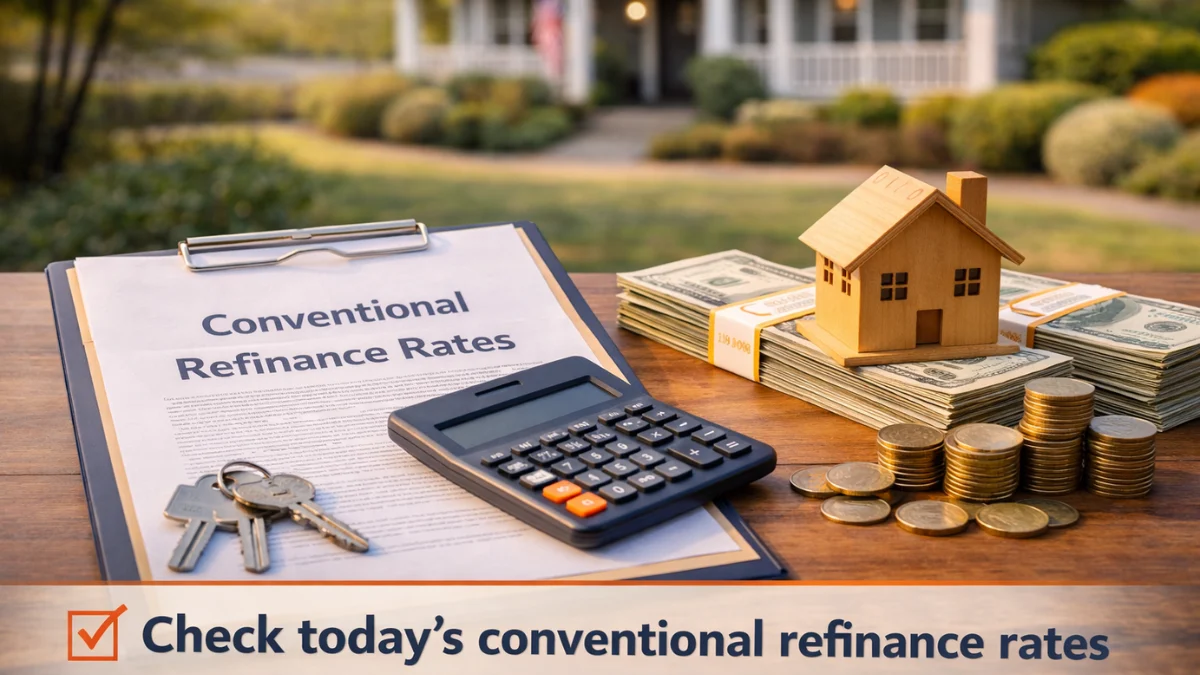
Check today’s conventional refinance rates (April 2026)
As of April 2026, conventional refinance rates are about 6.75% for 30-year fixed loans, 5.875% for 15-year terms, and around 5.375% for 5/5 ARMs. Rates vary based on credit score, equity, and lender conditions.
Understanding conventional refinance rates today helps homeowners decide whether now is a good time to replace their existing mortgage with a new conventional loan.
Typically to lower interest costs, reduce monthly payments, or eliminate mortgage insurance.
Refinancing pricing changes frequently based on the mortgage market, economic conditions, and lender risk policies.
This article explains where conventional refinance rates stand right now, what influences them, and how to interpret them for your refinance decision.
Conventional refinance rates today remain elevated but stable, offering opportunities for homeowners to reduce long-term costs.
As of early April 2026, 30-year fixed rates are around 6.75%, while 15-year options are lower near 5.875%.
Adjustable-rate mortgages (ARMs), such as 5/5 ARMs, can start as low as 5.375%.
These rates depend on credit score, loan-to-value ratio, and lender terms.
Comparing multiple lenders and negotiating terms can help borrowers secure the most competitive refinance rates available.
Current Average Conventional Refinance Rates
As of January, 2026, average nationwide refinance rates for conventional loans are roughly:
- 30-year fixed refinance: 6.54% (national average)
- 15-year fixed refinance: 5.89%
- 20-year fixed refinance: 6.37%
These figures come from widely reported mortgage market surveys and reflect broad conventional refinance pricing across lenders.
Variations by Lender and Loan Term
Different lenders publish their own rate trends, which can vary somewhat from national averages:
- Some lenders show 30-year conventional refinance rates near 6.125%-6.25% depending on loan size and borrower profile.
- Shorter terms (like 15-year fixed) can appear lower – sometimes nearer to 5.25%–5.50% on certain lender rate sheets.
This shows that today’s conventional refinance rates are influenced by your specific refinance goal, credit profile, and which lender you choose.
How Today’s Conventional Refinance Rates Compare to Broader Mortgage Market
National mortgage benchmarks such as the 30-year fixed mortgage average provide useful context for refinance pricing: recently, the average 30-year fixed mortgage hovered near 6.06%, reflecting broader market trends and influencing refinance rates too.
Because conventional refinance pricing is tied to overall mortgage conditions (bond markets, inflation expectations, lender risk appetite), today’s conventional refinance rates are similar to or slightly above many current purchase rate averages.
Why Conventional Refinance Rates Fluctuate
Several key factors influence conventional refinance rates today:
- Market interest rates & Treasury yields: Higher yields often mean higher mortgage rates.
- Inflation expectations: Persistent inflation pressure tends to push refinance rates up.
- Credit conditions and demand: Higher borrower demand for refinancing can affect pricing.
This is why today’s conventional refinance averages can change even over short periods.
Rate vs APR on Conventional Refinance
When comparing conventional refinance rates, it’s important to look at APR (Annual Percentage Rate) in addition to the interest rate.
APR includes most fees, points, and closing costs, giving a truer picture of your total borrowing cost.
A lower interest rate doesn’t always mean a lower overall cost if fees are high.
What These Rates Mean for Your Refinance Decision
Conventional refinance rates today are a starting point not a final answer. To determine whether refinancing makes sense for you, consider:
- How today’s rates compare to your current mortgage rate
- Your loan balance and equity level
- How long you plan to stay in the home
- Your goals (lower payment vs shorter term vs removing PMI)
Use a refinance calculator and compare personalized offers to see whether the refinance cost will be offset by monthly savings.
When Conventional Refinance Rates Make Sense
Refinancing becomes more compelling when:
- Your current rate is significantly higher than today’s averages
- You can eliminate mortgage insurance by lowering your loan-to-value
- You plan to stay in your home long enough to recoup closing costs
- You want to shorten your loan term and reduce total interest
These goals align well with what conventional refinance programs are built for.
When Rates May Not Justify Refinancing
It may not make sense to refinance if:
- Your current rate is very close to today’s averages
- Closing costs outweigh monthly savings
- You plan to sell or move soon
In such situations, waiting for better rate conditions or exploring alternatives may be wiser.
Conclusion
Conventional refinance rates today give you a snapshot of where the market i . Typically near the mid-6% range for 30-year fixed and the high-5% range for 15-year fixed but your actual rate will depend on your credit, equity, and lender pricing.
Always compare multiple refinance quotes and evaluate APR, closing costs, and long-term savings. With careful comparison and realistic goals, refinancing can help lower payments, improve terms, and strengthen your long-term financial position.
Mortgage Calculator
Recommended Mortgage Tools
Refinance Break-Even Calculator
See how long it takes to recover refinance costs.
Debt-to-Income Ratio Calculator
Check if your income supports mortgage approval.
Refinance Readiness Checker
Find out if now is the right time to refinance.
Mortgage Eligibility Checker
Quickly see if you qualify for a home loan.
First-Time Buyer Readiness
Know if you're ready to buy your first home.
Mortgage Pre-Approval Calculator
Estimate how much you can borrow instantly.
Next Read
Featured Mortgage Insights
Mortgage forbearance is becoming a relief option some homeowners explore when financial pressure makes monthly payments difficult. During periods of income disruption or rising expenses, mortgage forbearance may allow borrowers to temporarily pause or reduce payments while they stabilize their finances and avoid falling behind on their home loan.

Featured Mortgage Insights
Many buyers are approaching home loans more cautiously this year as mortgage rates, affordability concerns, and economic uncertainty influence borrowing decisions. Instead of rushing into purchases, borrowers are carefully evaluating financial readiness and long-term repayment stability before committing.
Featured Mortgage Insights
Mortgage forbearance is a temporary relief option that allows homeowners to pause or reduce mortgage payments during financial hardship. As household budgets tighten and unexpected expenses appear, some borrowers are turning to mortgage forbearance as a short-term way to stabilize finances while keeping their home loan in good standing.



About the Author: Ratiranjan Singha